The Vagus Nerve and Anxiety: 7 Exercises That Actually Help
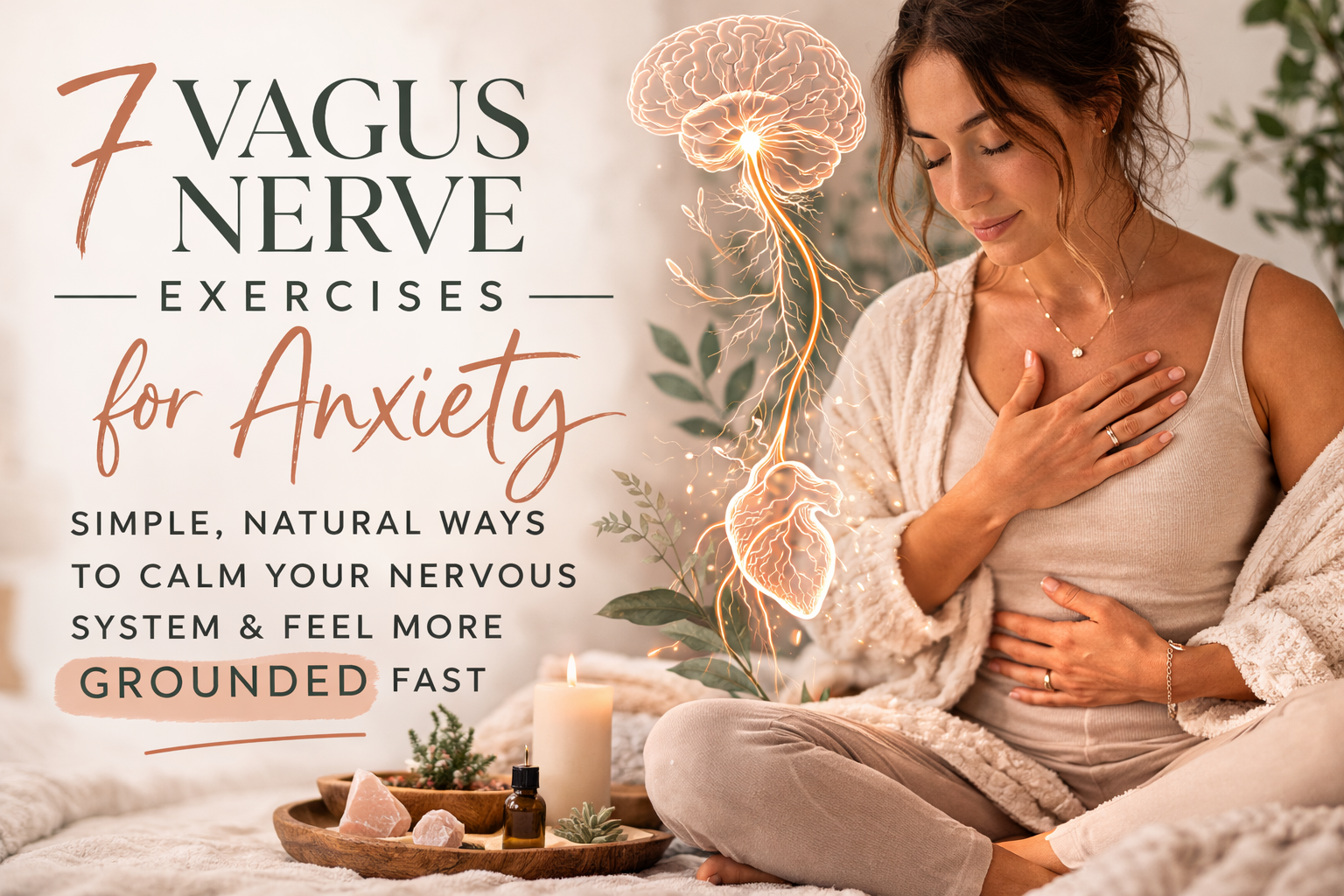
If anxiety is something you live with — the tight chest before difficult conversations, the looping thoughts at 3am, the sense of being perpetually braced for something — you've probably tried a lot of things. Journalling. Meditation. Therapy. Maybe medication. And yet the anxiety persists, living in your body like a low hum you can't quite turn off.
Here's something that might reframe everything: anxiety is not a flaw in your thinking. It is a state in your nervous system. And one of the most direct ways to change that state is through a nerve you've probably never paid conscious attention to — until now.
The vagus nerve.
Understanding this nerve — and learning how to work with it — is one of the most genuinely useful things I've encountered in a decade of somatic healing practice. Because when you know how to stimulate your vagus nerve, you have access to your body's own built-in anxiety off-switch, available to you at any moment, requiring nothing but your breath and your attention.
What Is the Vagus Nerve?
The vagus nerve is the longest cranial nerve in the body. It runs from the brainstem all the way down through the neck, past the heart and lungs, and into the gut — touching almost every major organ system along the way. The word vagus comes from the Latin for "wandering," which is exactly what it does.
It is the primary highway of the parasympathetic nervous system — what we call the rest-and-digest system, the counterpart to the fight-or-flight response. When the vagus nerve is active and healthy, your body can shift out of stress mode and into genuine calm. Heart rate slows. Digestion resumes. Muscles soften. The sense of threat begins to recede.
About 80% of the fibres in the vagus nerve are afferent — meaning they carry information upward, from the body to the brain. Your body is constantly sending signals about your safety and state through this nerve. This is why somatic approaches to healing — working with the body — can shift your emotional and psychological state so profoundly and so quickly. You are not just thinking your way to calm. You are signalling it, physiologically, from the body up.
What Is Vagal Tone — And Why Does It Drive Anxiety?
Vagal tone is a measure of how active and responsive your vagus nerve is. It is most accurately assessed through heart rate variability (HRV) — the natural variation between heartbeats that reflects how fluidly your nervous system moves between states.
High vagal tone means your nervous system is flexible and resilient. Stress activates it, and then it recovers. You feel anxious before a difficult conversation and then settle afterward. You sleep well. You can tolerate emotional intensity without being overwhelmed.
Low vagal tone means the system gets stuck. The fight-or-flight response switches on — and struggles to switch back off. The result is the experience of chronic anxiety: a nervous system in a state of persistent low-grade alert, perceiving threat even when the present moment is objectively safe.
This is not a character weakness. It is a physiological pattern — one that can be changed. Vagal tone is not fixed. Like cardiovascular fitness, it can be trained and improved through consistent practice.
The Vagus Nerve, Polyvagal Theory, and Anxiety
To understand why vagal stimulation matters so specifically for anxiety, it helps to know a little about Polyvagal Theory — the groundbreaking framework developed by neuroscientist Dr. Stephen Porges.
Porges identified that the vagus nerve has two distinct branches that govern very different states. The ventral vagal pathway supports what he called the social engagement system — calm alertness, connection, openness, and the felt sense of safety. When this pathway is active, anxiety recedes. We feel present, regulated, and capable.
When the nervous system perceives threat and the ventral vagal pathway goes offline, we shift into sympathetic activation — the anxious, hypervigilant state most of us recognise as anxiety. If the threat feels overwhelming, we may drop further into dorsal vagal shutdown — numbness, flatness, disconnection.
Vagus nerve exercises work by directly strengthening and activating the ventral vagal pathway — helping the nervous system return to a state of calm, connected safety. Not through thinking differently about anxiety, but through shifting the body's physiology beneath it.
7 Vagus Nerve Exercises for Anxiety
Exercise 01
Extended Exhale Breathing
Why it works: Your heart rate rises slightly on each inhale and drops on each exhale. A long exhale directly activates the parasympathetic nervous system through the vagus nerve, reducing cortisol, slowing heart rate, and signalling safety to your entire body. This is the single most accessible and evidence-supported vagal exercise available.
Exercise 02
The Physiological Sigh (Cyclic Sighing)
Why it works: Stanford researchers identified this as the most effective single breath technique for rapidly reducing anxiety and improving mood — outperforming both box breathing and mindfulness meditation in direct comparison. The double inhale fully re-inflates the air sacs in the lungs and resets CO2 balance; the long exhale maximally activates the parasympathetic response. Your body uses this breath spontaneously when under stress — you are simply making it intentional.
Exercise 03
Humming on the Exhale
Why it works: The vagus nerve passes directly through the larynx. Humming creates vibrations that physically stimulate the vagal nerve, activating the parasympathetic system and — crucially — the ventral vagal pathway associated with social safety and calm. This is why toning and chanting have been used in healing traditions across cultures for thousands of years.
Exercise 04
Cold Water on the Face
Why it works: Cold water on the face triggers the mammalian dive reflex — an immediate, automatic parasympathetic response that slows heart rate and activates the vagus nerve. It is one of the fastest-acting nervous system regulation tools available, which is why it is included in clinical emotion regulation protocols specifically for managing intense anxiety and emotional overwhelm.
Exercise 05
Gargling
Why it works: The muscles at the back of the throat are directly innervated by the vagus nerve. Vigorous gargling activates these muscles, sending stimulation along the vagal pathway and activating the parasympathetic response. Simple, free, and surprisingly effective as a regular daily practice.
Exercise 06
Somatic Grounding Through the Feet
Why it works: Anxiety often involves the nervous system losing its orientation to the present moment — getting pulled into anticipated threat or looping memory. Proprioceptive input — the felt sense of the body in physical space — helps the nervous system orient to here and now. Polyvagal Theory identifies this kind of present-moment orientation as a primary route to ventral vagal activation and the felt sense of safety.
Exercise 07
Guided Somatic Breathwork
Why it works: The first six exercises are powerful tools for moment-to-moment anxiety relief and for gradually building vagal tone over time. Guided somatic breathwork goes to a different depth entirely. By combining conscious breath with body awareness in a supported therapeutic space, it accesses the nervous system patterns, stored stress, and held emotional material that underlie chronic anxiety — not just managing the symptoms, but beginning to heal the source.
At a Glance: All 7 Exercises
| # | Exercise | Time | Best For |
|---|---|---|---|
| 1 | Extended Exhale Breathing | 3–5 min | Acute anxiety, daily practice |
| 2 | Physiological Sigh | 2–3 min | Anxiety spikes, panic |
| 3 | Humming on the Exhale | 2–3 min | Tension, feeling unsafe |
| 4 | Cold Water on the Face | 30–60 sec | Intense anxiety, overwhelm |
| 5 | Gargling | 30–60 sec | Daily vagal toning |
| 6 | Somatic Grounding | 3–5 min | Dissociation, disconnection |
| 7 | Guided Somatic Breathwork | 40–60 min | Deep healing, lasting change |
How to Build These Into a Practice
The exercises that work best in a moment of acute anxiety are the ones your nervous system has already practised — which is why building a daily routine matters. Even five minutes each morning of extended exhale breathing or the physiological sigh begins to train vagal tone so that the shift comes more quickly when you need it most.
A simple daily practice might look like this: start each morning with 5 minutes of extended exhale breathing. Gargle with water as part of your morning routine. Use the physiological sigh or cold water on the face when anxiety spikes during the day. Add a guided somatic breathwork session once or twice a month to go deeper.
Over time — weeks and months of consistent practice — you will likely notice something shift. Not just that you have tools for managing anxiety in the moment, but that the baseline changes. The nervous system becomes less reactive, more resilient. Anxiety has a lower set point. Recovery happens faster. The body begins to know, in a way it simply couldn't before, that it is safe.
"You cannot think your way out of a nervous system state. But you can breathe your way toward a different one — and with practice, your nervous system learns to make that journey faster, with less effort, and from a higher baseline of calm."
When Daily Exercises Aren't Enough
If anxiety has been a persistent companion for years — if it runs deep, if it has roots in difficult early experiences or accumulated trauma — vagus nerve exercises are a vital part of the toolkit. But they may not be sufficient on their own.
Chronic anxiety rooted in trauma or long-established nervous system patterns needs more than regulation techniques. It needs the deeper somatic healing work: the inner child healing, the parts work, the processing of what the nervous system has been carrying. This is the work I offer in my 1:1 sessions — and it is where the most profound and lasting shifts happen.
Ready to work with your vagus nerve at a deeper level?
My 1:1 Integrative Somatic Breathwork sessions are designed to train your vagal tone, calm your nervous system, and begin healing the patterns beneath chronic anxiety — not just manage them.
Book a Breathwork Session with Rachel →Frequently Asked Questions
What is the vagus nerve and what does it have to do with anxiety?
The vagus nerve is the longest nerve in the body, running from the brainstem through the heart, lungs, and gut. It is the primary pathway of the parasympathetic nervous system. When vagal tone is low, the nervous system struggles to shift out of anxiety and stress mode. Stimulating the vagus nerve directly activates the calming parasympathetic response, reducing anxiety at a physiological level.
What are the best vagus nerve exercises for anxiety?
The most evidence-supported exercises include extended exhale breathing (inhale 4, exhale 8), the physiological sigh, humming or toning, cold water on the face, gargling, somatic grounding, and guided somatic breathwork. Each directly stimulates the vagus nerve and activates the parasympathetic response.
How quickly do vagus nerve exercises reduce anxiety?
Extended exhale breathing, the physiological sigh, and cold water on the face can produce measurable anxiety reduction within 2 to 5 minutes. Consistent daily practice over weeks and months gradually improves vagal tone and lowers the chronic anxiety baseline.
What is vagal tone and why does it matter for anxiety?
Vagal tone measures how active and responsive the vagus nerve is. High vagal tone means the nervous system shifts fluidly between activation and calm. Low vagal tone means the system gets stuck in stress mode, producing chronic anxiety and difficulty relaxing. Vagal tone can be trained through consistent breathwork and somatic practices.
Does humming really help with anxiety?
Yes. The vagus nerve passes directly through the larynx. Humming creates vibrations that physically stimulate the vagal nerve, activating the parasympathetic response and the social engagement system associated with safety and calm. Even 2 to 3 minutes of humming on the exhale can produce a noticeable shift in anxiety levels.
Can you fix chronic anxiety through vagus nerve exercises alone?
Vagus nerve exercises are powerful for both acute relief and building long-term resilience. For chronic anxiety rooted in trauma or long-established nervous system patterns, daily exercises work best alongside deeper somatic healing work that addresses underlying patterns.
What is the physiological sigh and how does it help anxiety?
The physiological sigh involves a double inhale through the nose followed by a long, slow exhale through the mouth. Stanford researchers identified it as the most effective single breath technique for rapidly reducing anxiety and improving mood.
How is breathwork different from regular deep breathing for anxiety?
Regular deep breathing is a general relaxation technique. Integrative somatic breathwork uses specific breath patterns combined with body awareness to access and release stored stress and nervous system patterns — creating deeper and more lasting relief from anxiety.