Healing Perfectionism: Why High Achievers Struggle with Anxiety
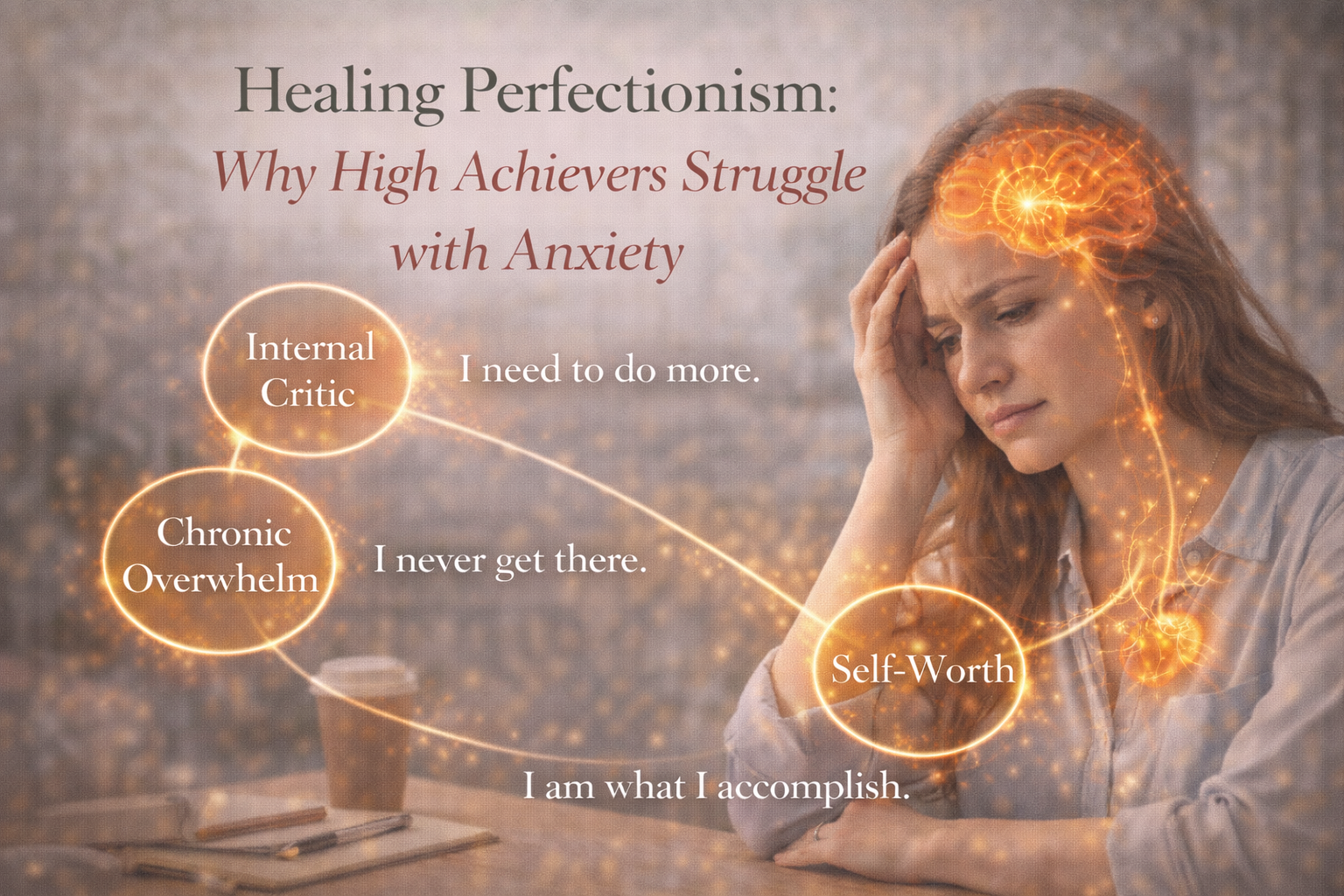
Perfectionism is often praised in our culture. It can look like discipline, ambition, high standards, responsibility, excellence, and success. From the outside, it may even seem admirable.
But inside the body, perfectionism often feels very different.
It can feel like chronic pressure. Anxiety before you begin. Tension while you work. Fear of making mistakes. Never quite feeling done. Never quite feeling good enough. Constantly moving the goalpost, even after you've done something well.
This is why so many high achievers struggle with anxiety. What looks like motivation on the outside is often, at least in part, a nervous system strategy for staying safe.
Quick Summary: Why Perfectionism Creates Anxiety
Perfectionism can create anxiety when the nervous system starts believing that safety depends on:
- Getting everything right
- Avoiding mistakes
- Being prepared for every outcome
- Performing at a high level at all times
- Earning worth through productivity or success
- Preventing criticism, shame, or disappointment
When the body is organized around those beliefs, rest can feel unsafe, mistakes can feel threatening, and “not enough” can feel like danger.
What Is Perfectionism, Really?
Perfectionism is often described as having high standards, but that definition is too simple.
At its core, perfectionism is usually not about excellence. It is about protection.
It is the belief, often beneath conscious awareness, that if you can be good enough, polished enough, productive enough, prepared enough, or mistake-free enough, then you can avoid pain. Criticism. Rejection. Failure. Shame. Disappointment. Vulnerability.
In that sense, perfectionism is not random. It makes sense as a strategy — especially for people whose nervous systems learned that mistakes carried emotional consequences.
Why High Achievers Struggle With Anxiety
High achievers often know how to perform, produce, and keep going. They know how to meet expectations, get things done, and function at a high level. But many are carrying a body that never fully relaxes.
That is because high achievement can become deeply intertwined with nervous system safety.
If your body learned that achievement brings approval, belonging, praise, love, control, or protection from criticism, then striving may feel stabilizing — even when it is also depleting you.
This creates a painful paradox: the very thing that helps you feel temporarily safe can also be the thing that keeps your anxiety going.
How Perfectionism Shows Up in the Nervous System
Pattern 01
Chronic Overthinking
What it can mean: Your nervous system may be trying to predict and prevent danger through control, preparation, and mental scanning.
Pattern 02
Difficulty Starting or Finishing
What it can mean: Perfectionism can create so much internal pressure that the body goes into activation or shutdown before action even begins.
Pattern 03
Never Feeling Done
What it can mean: The nervous system may not trust completion as safe. If worth is tied to striving, stopping can feel uncomfortable or exposed.
Pattern 04
Rest Feeling Uncomfortable
What it can mean: Your body may associate productivity with safety and stillness with vulnerability, laziness, or loss of control.
Pattern 05
Fear of Being Seen Imperfectly
What it can mean: The body may experience imperfection as social or emotional threat, not just discomfort.
Perfectionism as a Survival Strategy
For many people, perfectionism develops in response to environments where mistakes did not feel safe.
Maybe love, praise, or attention were linked to achievement. Maybe criticism was harsh. Maybe there was a lot of pressure to perform, be responsible, or “do it right.” Maybe being easy, capable, and successful became part of how you stayed connected or protected yourself from shame.
In those contexts, perfectionism makes sense. It becomes a strategy for managing uncertainty and protecting belonging.
This is why healing perfectionism is not about shaming yourself for having it. It is about understanding what your body has been trying to do for you.
Common Signs Perfectionism Is Anxiety-Driven
| If you notice... | It may point to... | Why it matters |
|---|---|---|
| You cannot relax unless everything is done | Achievement tied to safety | The body may not trust rest |
| You obsess over mistakes | Shame sensitivity | Imperfection may feel threatening |
| You over-prepare for everything | Anxiety and control | Preparation becomes protection |
| You avoid starting unless you can do it perfectly | Freeze response | Pressure overwhelms the system |
| You achieve a lot but rarely feel satisfied | Chronic nervous system striving | Safety is sought through doing, not being |
Why Insight Alone Often Isn't Enough
You may already know you are perfectionistic. You may even understand where it comes from. And still, your body may tense up when something is imperfect, unfinished, visible, or uncertain.
That does not mean you are failing.
It means perfectionism likely lives deeper than mindset alone. It lives in the body's stress response around mistakes, vulnerability, judgment, and loss of control.
This is why healing often needs to include the nervous system, not just new beliefs.
How to Begin Healing Perfectionism
Healing Step 01
Notice the Body Under the Pattern
Why it helps: This shifts perfectionism from being an identity trait to being something you can observe as a nervous system pattern.
Healing Step 02
Practice Safe Imperfection in Small Doses
Why it helps: The nervous system learns through lived experience. Small moments of tolerated imperfection help the body discover that mistakes or incompleteness do not equal catastrophe.
Healing Step 03
Regulate Before You Overwork
Why it helps: A regulated system works differently than an anxious one. This helps reduce the urge to produce from panic, urgency, or self-attack.
Healing Step 04
Separate Worth From Output
Why it helps: Perfectionism often collapses worth into output. Healing requires creating a new relationship with being human, not just doing well.
Healing Step 05
Build Capacity for Rest and Enoughness
Why it helps: Rest may feel unsafe to a system organized around achievement. Building tolerance for enoughness is part of healing.
What Healing Perfectionism Actually Looks Like
Healing perfectionism does not mean becoming careless, unmotivated, or indifferent. It means your excellence is no longer fueled by fear.
It can look like:
- Starting before everything feels perfect
- Making a mistake without spiraling into shame
- Finishing something without endless revising
- Resting without feeling like you have to earn it
- Staying connected to yourself even when you disappoint someone
- Creating from truth instead of pressure
In other words, it is not about lowering your standards. It is about changing the energy underneath them.
"Perfectionism often looks like excellence, but in the body it often feels like fear. Healing begins when safety no longer depends on getting everything right."
How Somatic Healing Helps
Somatic healing helps perfectionism by working with the body's fear around mistakes, visibility, rest, uncertainty, and losing control.
Through breathwork, grounding, body awareness, nervous system regulation, and compassionate inner work, the body can begin to experience a new reality: that imperfection is survivable, rest is allowed, and worth does not have to be earned through constant striving.
That is when high achievement can start to feel more aligned, sustainable, and human.
Ready to heal the anxiety beneath perfectionism?
My 1:1 Integrative Somatic Breathwork sessions help calm the nervous system, soften survival-based striving, and support more safety, self-trust, and ease in your body.
Book a Breathwork Session with Rachel →Frequently Asked Questions
Why are perfectionism and anxiety connected?
Perfectionism and anxiety are often connected because perfectionism can function as a protective strategy. The nervous system may believe that being perfect, prepared, productive, or in control will prevent criticism, rejection, failure, or shame. This creates chronic pressure and anxiety.
Is perfectionism a trauma response?
Perfectionism can be a trauma-related adaptation or nervous system survival strategy for some people. It often develops in environments where mistakes felt unsafe, love felt conditional, or high performance was linked to worth, approval, or emotional safety.
Why do high achievers struggle with anxiety?
High achievers often struggle with anxiety because success can become tied to safety, identity, control, or self-worth. When the nervous system believes it must constantly perform to stay safe or valuable, pressure and anxiety can become chronic.
How do you start healing perfectionism?
Healing perfectionism often involves nervous system regulation, self-compassion, body awareness, boundaries, slowing down, and learning to tolerate imperfection without collapsing into shame, panic, or overworking.
Can somatic healing help perfectionism?
Yes. Somatic healing can help perfectionism by working with the body's stress response around mistakes, visibility, performance, and control. It helps create more safety in being human instead of constantly striving to get everything right.