People Pleasing and the Nervous System: Why Saying No Feels Unsafe
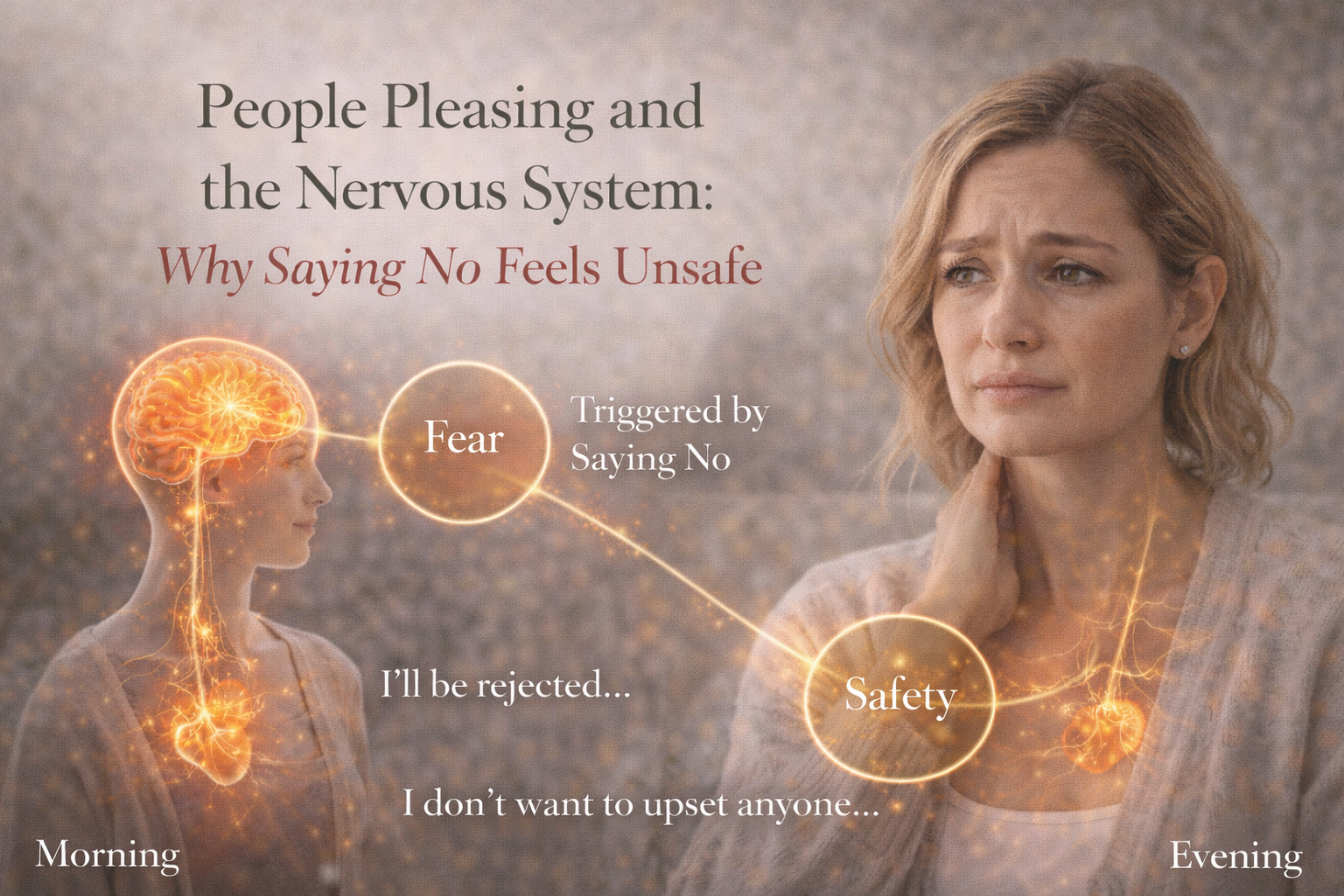
If you know how to show up for everyone else but struggle to say no, ask for what you need, or tolerate disappointing people, you are not alone.
People pleasing is often misunderstood as simply being “too nice” or lacking boundaries. But for many people, it runs much deeper than personality. It is a nervous system pattern.
When saying no feels unsafe, when conflict feels threatening, or when someone else's disappointment feels almost unbearable, that reaction is often not just mental. It is physiological. Your body may be responding as if self-protection depends on keeping the peace.
This is why people pleasing can feel so hard to “just stop.” It is not only a habit. It can be a survival strategy your nervous system learned for a reason.
Quick Summary: Why People Pleasing Happens
People pleasing often develops when the nervous system learns that safety comes from:
- Keeping others happy
- Avoiding conflict or criticism
- Staying agreeable and easy to manage
- Ignoring your own needs to protect connection
- Reading the room and adapting quickly
This pattern is often linked to the fawn response — a survival strategy where appeasing others feels safer than expressing yourself honestly.
What Is People Pleasing From a Nervous System Perspective?
From a nervous system perspective, people pleasing can be a way the body tries to prevent threat. That threat may not be physical. It may be emotional: disapproval, rejection, anger, conflict, withdrawal, shame, or the fear of being “too much.”
If your body learned early on that connection depended on self-abandonment, accommodation, or staying hyper-aware of other people's needs, then pleasing may have become the path of least danger.
In that context, saying yes when you mean no is not random. It is protective.
Why Saying No Feels Unsafe
For many people, saying no does not just feel uncomfortable. It feels risky.
You may know logically that setting a boundary is healthy, but your body may still react with anxiety, guilt, tightness, panic, or the urge to immediately soften, explain, over-accommodate, or take it back.
This is because your nervous system may associate boundaries with:
- Conflict
- Criticism
- Rejection
- Disconnection
- Being seen as selfish, difficult, or unkind
- Losing approval, love, or belonging
When those associations live in the body, “no” can feel like danger — even when it is the healthiest possible answer.
The Fawn Response Explained
The fawn response is a survival pattern in which someone copes with threat by appeasing, accommodating, or prioritizing other people in order to stay safe.
Just as fight, flight, and freeze are nervous system responses, fawning is also protective. It often develops in environments where direct expression did not feel safe, where emotional attunement was inconsistent, or where conflict carried significant consequences.
| Survival response | What it looks like | Protective goal |
|---|---|---|
| Fight | Push back, defend, control | Protect through power |
| Flight | Escape, overwork, overthink | Protect through movement |
| Freeze | Shut down, go numb, disconnect | Protect through immobility |
| Fawn | Appease, accommodate, self-abandon | Protect through relational safety |
The fawn response is often especially common in people who are highly empathetic, sensitive, relationally aware, or grew up needing to manage other people's emotions in order to feel safe.
Common Signs of People Pleasing
Sign 01
You Say Yes When You Mean No
What it can mean: Your body may prioritize immediate relational safety over your actual capacity or truth.
Sign 02
You Feel Responsible for Other People's Feelings
What it can mean: Your nervous system may have learned to monitor others in order to stay safe and connected.
Sign 03
You Over-Explain Your Boundaries
What it can mean: Your body may not yet trust that a simple boundary is enough without earning permission or understanding.
Sign 04
Conflict Feels Disproportionately Threatening
What it can mean: The nervous system may experience disagreement as danger rather than discomfort.
Sign 05
You Lose Touch With What You Actually Want
What it can mean: Chronic self-abandonment can disconnect you from your own body's signals, needs, and preferences.
How People Pleasing Affects the Body
People pleasing is not only relational. It is somatic.
It can live in the body as tightness in the chest, a lump in the throat, shallow breathing, stomach knots, tension before difficult conversations, exhaustion after social interactions, and chronic anxiety around boundaries.
This is one reason healing people pleasing is not only about scripts. It is also about helping the body tolerate honesty, limits, and the possibility of another person's discomfort without going into survival mode.
Why Insight Alone Often Doesn't Change It
You can understand your pattern intellectually and still find yourself saying yes automatically. That does not mean you are failing. It means the pattern likely lives deeper than thought.
If your body believes pleasing equals safety, then a new behavior like setting a boundary may trigger a stress response even when your mind agrees with it.
That is why healing often needs to be both cognitive and somatic. You need insight, yes. But you also need your nervous system to learn a new experience.
How to Begin Healing People Pleasing
Healing Step 01
Notice the Body Response Before the Yes
Why it helps: Awareness is the first step. You cannot shift an automatic pattern if you do not first notice the body's response.
Healing Step 02
Practice Small, Safe Nos
Why it helps: The nervous system learns through lived experience. Small boundaries help the body discover that honesty can survive contact with real life.
Healing Step 03
Regulate the Guilt Instead of Obeying It
Why it helps: Guilt often appears when old relational patterns are challenged. Regulation helps you stay with the discomfort without immediately abandoning yourself.
Healing Step 04
Reconnect With Your Own Needs
Why it helps: People pleasing often disconnects you from your inner signals. Rebuilding that connection is essential to sustainable boundaries.
Healing Step 05
Work With the Parts of You That Learned This Pattern
Why it helps: Healing happens more effectively when you understand the protective intelligence beneath the pattern instead of attacking yourself for having it.
What Healthy Boundaries Feel Like in the Body
At first, healthy boundaries may not feel calm. They may feel shaky, tender, guilty, or unfamiliar.
That does not mean they are wrong.
Over time, as your nervous system learns that you can survive honesty, tolerate disappointment, and remain connected to yourself, boundaries begin to feel less like danger and more like self-respect.
Eventually, a healthy no can feel grounding instead of terrifying.
"People pleasing is not proof that you are weak. It is often proof that your nervous system learned connection mattered so much that self-abandonment began to feel safer than honesty."
How Somatic Healing Helps
Somatic healing helps people pleasing at the level where it actually lives: in the body and nervous system.
Through breathwork, grounding, body awareness, nervous system regulation, inner child healing, and trauma-informed support, the body can begin to experience a new truth: that you can be kind without abandoning yourself, connected without shape-shifting, and safe without always saying yes.
The goal is not to become harsh. It is to become more honest, more embodied, and more able to stay with yourself.
Ready to heal the pattern beneath people pleasing?
My 1:1 Integrative Somatic Breathwork sessions help you calm the nervous system, build self-trust, and create more safety around boundaries, needs, and honest self-expression.
Book a Breathwork Session with Rachel →Frequently Asked Questions
Is people pleasing a nervous system response?
Yes. People pleasing can be a nervous system response, especially when the body has learned that harmony, approval, or keeping others happy feels safer than conflict, rejection, or disconnection. It is often connected to the fawn response.
Why does saying no feel unsafe?
Saying no can feel unsafe when your nervous system associates boundaries with conflict, loss of love, criticism, punishment, or emotional disconnection. Even if a boundary is healthy, the body may still interpret it as danger.
What is the fawn response?
The fawn response is a survival pattern where someone copes with stress or threat by appeasing, accommodating, or prioritizing others in order to stay safe. It is often rooted in attachment wounds, trauma, or chronic environments where self-abandonment felt necessary.
How do you stop people pleasing?
Healing people pleasing often involves nervous system regulation, body awareness, boundaries work, self-trust, inner child healing, and learning to tolerate the discomfort of disappointing others without abandoning yourself.
Can somatic healing help with people pleasing?
Yes. Somatic healing can help with people pleasing by working with the body's fear response around conflict, boundaries, and self-expression. It helps build a felt sense of safety in saying no, honoring needs, and staying connected to yourself.