Inner Child Healing Explained: Why Your Past Still Lives in Your Nervous System
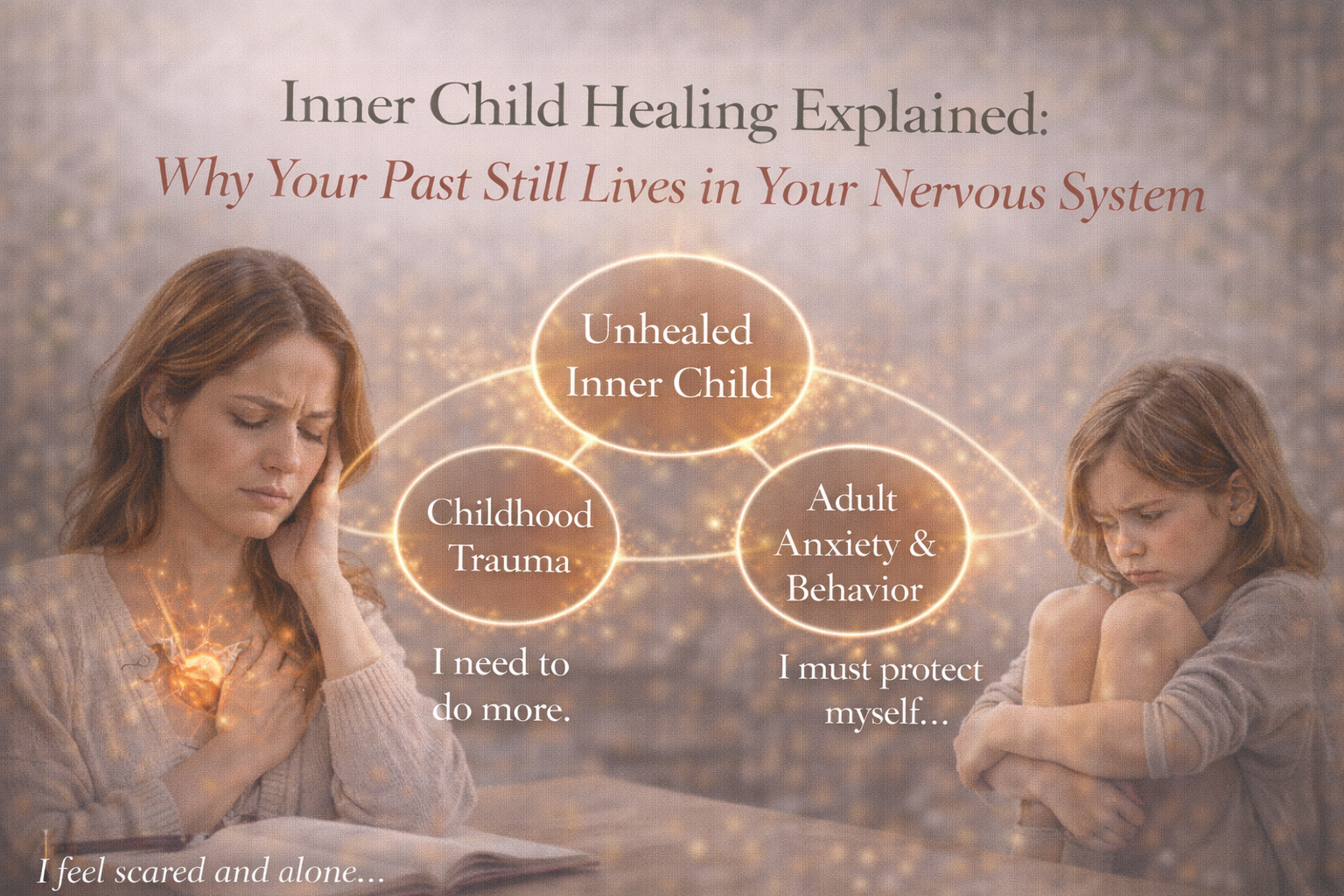
If you have ever had a reaction that felt bigger than the moment — intense anxiety, deep shame, fear of rejection, people pleasing, shutdown, or a sense of feeling “small” — you may have already felt the presence of your inner child, even if you did not call it that.
Inner child healing is often talked about in spiritual and therapeutic spaces, but at its core, it is actually very simple: parts of you learned how to survive early experiences, and those parts may still be influencing how you feel, react, connect, and protect yourself now.
This is why your past can still live in your nervous system long after the original experiences are over. The mind may know you are an adult. But the body can still carry younger patterns of fear, bracing, shame, loneliness, or hypervigilance.
Inner child healing is the process of meeting those younger parts with the safety, compassion, and care they may not have fully received the first time around.
Quick Summary: What Inner Child Healing Means
Inner child healing is about tending to the younger parts of you that still carry:
- Unmet emotional needs
- Fear, shame, or loneliness
- Protective survival patterns
- Nervous system responses shaped by childhood experiences
- Beliefs about safety, love, worth, and belonging
It is not about blaming the past for everything. It is about understanding that the body often keeps carrying what it never got to fully process, feel, or repair.
What Is Inner Child Healing?
Inner child healing is the process of reconnecting with and caring for the younger parts of yourself that still hold emotional wounds, unmet needs, and protective patterns from earlier life experiences.
These parts are not imaginary. They are often alive in your nervous system, emotions, triggers, and relational patterns. They may show up when you feel abandoned, criticized, unseen, not enough, overwhelmed, or afraid to express yourself honestly.
Inner child healing does not mean you are “stuck in the past.” It means you are recognizing that parts of your system may still be organized around experiences that happened earlier in life.
Why Your Past Still Lives in Your Nervous System
Your nervous system learns through experience. It takes in information about what feels safe, what feels threatening, what gets love, what leads to shame, what helps you stay connected, and what you need to do to survive emotionally.
If you grew up in an environment where you had to be careful, pleasing, high-achieving, emotionally self-sufficient, or hyper-aware of other people, your body may have adapted in ways that still affect you now.
This can look like:
- Anxiety around conflict or disapproval
- People pleasing and difficulty setting boundaries
- Perfectionism and chronic pressure
- Fear of being too much or not enough
- Shame that gets activated quickly
- Shutdown, numbness, or dissociation when overwhelmed
- A deep longing to feel safe, seen, chosen, or soothed
These patterns are often not signs of weakness. They are signs of adaptation.
What Inner Child Wounds Can Look Like in Adult Life
Pattern 01
Fear of Rejection
What it can mean: A younger part of you may still carry fear that disconnection or disappointment is dangerous.
Pattern 02
Feeling Not Good Enough
What it can mean: A younger part may still be trying to earn worth, approval, or love through performance.
Pattern 03
Difficulty Asking for Needs
What it can mean: Your system may have learned that needs were inconvenient, unsafe, or unlikely to be met.
Pattern 04
Over-Responsibility
What it can mean: A younger part may have learned to grow up quickly, stay capable, or manage a lot in order to feel safe.
Pattern 05
Emotional Shutdown
What it can mean: The body may have learned that feeling fully was too overwhelming or unsupported, so it adapted through disconnection.
Inner Child Healing and the Nervous System
Inner child work is not only emotional. It is somatic.
Younger wounds often live in the body through nervous system patterns. That is why triggers can feel immediate, physical, and disproportionate. Your chest tightens. Your stomach drops. Your breath changes. You feel panic, collapse, urgency, or shame before your mind can even make sense of it.
This is what it means for the past to still live in the nervous system. The body is reacting to something current through a pattern that may have been shaped long ago.
Healing, then, is not only about understanding what happened. It is also about helping your body have a new experience now.
What Inner Child Healing Is Not
Inner child healing is not about becoming childish, blaming your parents for everything, or getting lost in old stories without moving forward.
It is not about forcing yourself to relive pain before your system is ready.
And it is not about treating yourself like something is broken.
Instead, it is about offering compassion and repair to the parts of you that learned to survive in the only ways they knew how.
| Inner child healing is... | Inner child healing is not... |
|---|---|
| Compassionate re-parenting | Self-indulgence |
| Nervous system repair | Staying stuck in the past |
| Meeting unmet needs with care | Blaming without healing |
| Understanding triggers with curiosity | Judging yourself for having them |
| Creating new experiences of safety | Forcing emotional intensity |
How to Start Inner Child Healing
Healing Step 01
Notice When You Feel “Small”
Why it helps: These moments often point toward an activated younger part that needs attention, not judgment.
Healing Step 02
Bring Curiosity to the Trigger
Why it helps: Curiosity interrupts shame and helps you relate to your reaction as something meaningful rather than something wrong.
Healing Step 03
Offer the Younger Part What It Needed
Why it helps: Healing happens when the body begins to receive a different experience than the one it originally internalized.
Healing Step 04
Use Somatic Grounding
Why it helps: Inner child healing is most effective when the body feels safe enough to stay present instead of getting pulled fully into old survival states.
Healing Step 05
Work With Support When Needed
Why it helps: Some inner child wounds need co-regulation, skilled support, and a safe relational container in order to heal more deeply.
What Healing the Inner Child Actually Looks Like
Inner child healing is not always dramatic. Sometimes it looks like crying in a new way. Sometimes it looks like finally feeling anger where there used to be only self-blame. Sometimes it looks like softness. Boundaries. Rest. Self-trust. Saying no. Asking for comfort. Feeling less ashamed of your needs.
It can also look quieter than people expect:
- Recovering faster after a trigger
- Feeling less reactive in relationships
- Being kinder to yourself when you make mistakes
- Noticing your needs sooner
- Feeling safer inside your own body
- Trusting that your emotions make sense
Healing is often the slow return of safety, not just a big emotional breakthrough.
"Inner child healing is not about going backward. It is about bringing safety, compassion, and presence to the parts of you that have been carrying the past alone."
Why Somatic Healing Helps So Much
Somatic healing is especially powerful for inner child work because younger wounds often live in the nervous system, not just in conscious memory. The body remembers through tension, bracing, people pleasing, shutdown, anxiety, and emotional triggers.
Through breathwork, grounding, body awareness, co-regulation, and trauma-informed support, the body begins to experience a new message: you are here now, you are not alone, and what once felt unsafe can be met differently.
That is when inner child healing stops being just an idea and becomes something your body can actually feel.
Ready to support the younger parts of you with more safety and compassion?
My 1:1 Integrative Somatic Breathwork sessions help calm the nervous system, support inner child healing, and create deeper repair at the level of the body.
Book a Breathwork Session with Rachel →Frequently Asked Questions
What is inner child healing?
Inner child healing is the process of tending to the younger parts of you that still carry unmet needs, emotional pain, protective patterns, and nervous system imprints from earlier life experiences. It involves creating safety, compassion, and repair where those parts may have once experienced fear, shame, loneliness, or disconnection.
Why does my past still live in my nervous system?
Your past can still live in your nervous system because the body stores patterns of protection shaped by earlier experiences. Even when events are over, the nervous system may still react through anxiety, people pleasing, shutdown, hypervigilance, or emotional overwhelm if it has not fully experienced safety and repair.
Is inner child healing the same as being childish?
No. Inner child healing is not about being childish. It is about caring for the younger parts of you that still hold pain, unmet needs, or protective strategies from the past. It is a healing practice, not immaturity.
How do you start inner child healing?
You can start inner child healing by building nervous system safety, noticing emotional triggers, offering self-compassion, journaling, working with younger parts of yourself, and using somatic practices that help the body feel grounded and supported.
Can somatic healing help with inner child work?
Yes. Somatic healing can be very supportive for inner child work because early wounds often live not only in thoughts and memories, but in the body and nervous system. Somatic practices help create the safety needed for deeper repair and integration.