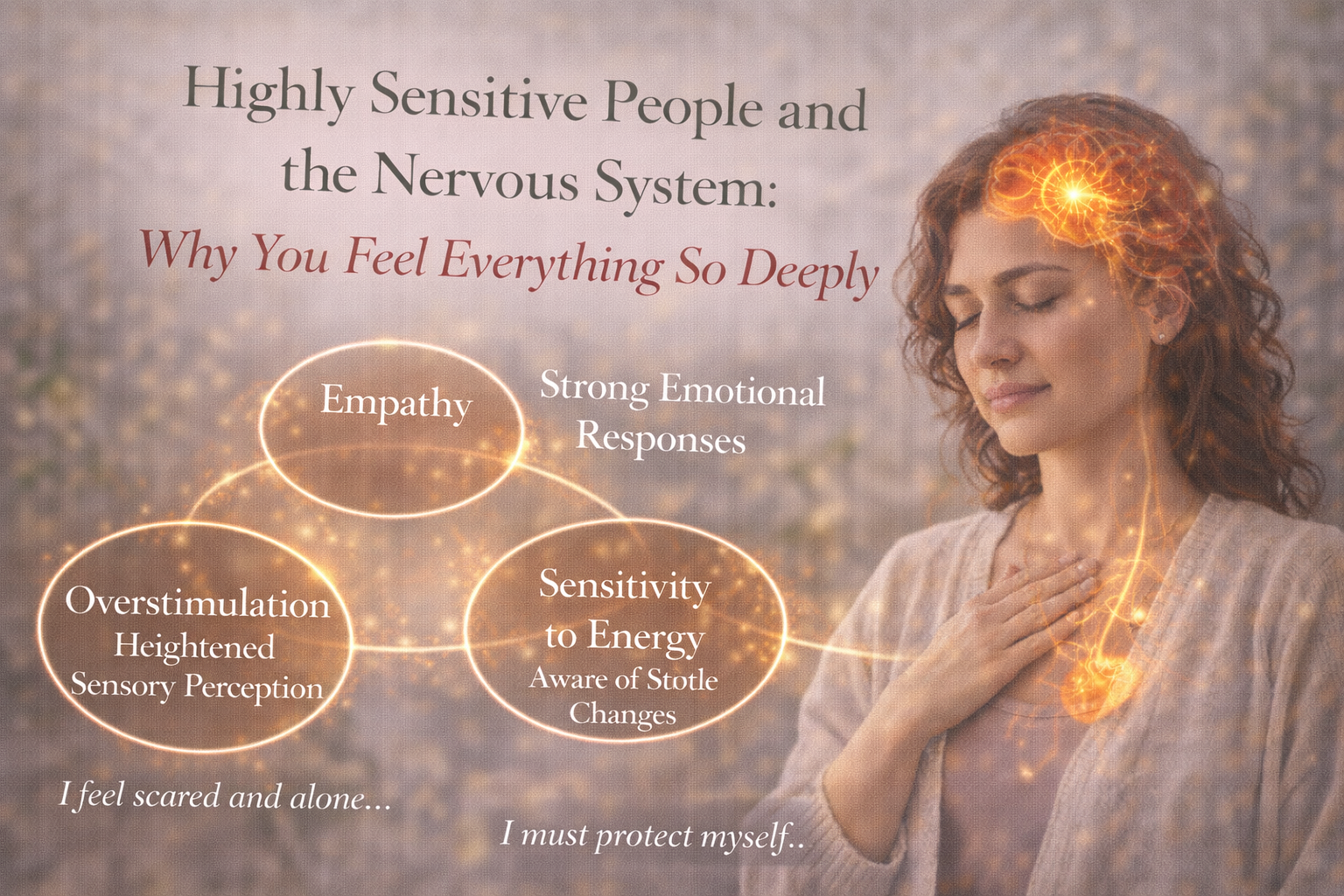
If you have ever been told that you are “too sensitive,” feel drained by overstimulation, pick up on subtle shifts in people's energy, or seem to feel everything more deeply than those around you, you may be a highly sensitive person.
And if that is true for you, there is nothing wrong with you.
High sensitivity is not a flaw. It is not weakness. And it is not something you need to shame yourself for. But it does often mean your nervous system processes the world differently — and more deeply.
This is why so many highly sensitive people feel intense emotions, become easily overstimulated, struggle with anxiety or overwhelm, and need more recovery time than others seem to. Your nervous system is taking in a lot. And when it does not have enough support, that depth can start to feel like too much.
Quick Summary: Why Highly Sensitive People Feel So Deeply
Highly sensitive people often have nervous systems that process more input, more deeply. This can mean:
- Greater sensitivity to noise, light, crowds, and stimulation
- More emotional depth and intensity
- Strong awareness of subtle cues and relational shifts
- Faster overwhelm when stress accumulates
- A deeper need for rest, alone time, and regulation
High sensitivity is not the same as fragility. It simply means your nervous system may need more intentional care, pacing, and support.
What Is a Highly Sensitive Person?
A highly sensitive person, often called an HSP, is someone who tends to process emotional, sensory, and relational information more deeply than average.
This can include being more affected by loud environments, conflict, other people's moods, time pressure, overstimulation, criticism, or emotionally intense experiences. It can also include deep empathy, intuition, creativity, rich inner life, and strong awareness of subtleties that others may miss.
In other words, sensitivity is not only about being easily overwhelmed. It is also about depth of perception.
How High Sensitivity Relates to the Nervous System
The nervous system is constantly taking in information from inside and outside the body. For highly sensitive people, that intake can feel amplified.
You may notice more. Feel more. Register more. And process more internally before you even realize it.
This can mean your body responds strongly to environments, other people, emotional tension, overstimulation, or subtle changes in energy. It does not mean you are imagining things. It means your system is picking up on more data.
When that much information comes in without enough grounding or recovery, the nervous system can become overloaded. That is often when sensitivity starts to look like anxiety, shutdown, or emotional exhaustion.
Why Highly Sensitive People Feel Everything So Deeply
Highly sensitive people often feel everything so deeply because their nervous systems do not skim life. They absorb it.
You may feel deeply affected by:
- Someone's tone of voice changing
- Conflict in a room, even when nobody says anything directly
- Busy, chaotic, or loud environments
- Sadness, beauty, grief, music, art, or meaningful moments
- Other people's pain or emotional energy
- Transitions, uncertainty, or too much happening at once
This depth can be beautiful. It can also be exhausting when you have not been taught how to support a sensitive nervous system.
High Sensitivity vs. Nervous System Dysregulation
Not every highly sensitive person is dysregulated. And not every dysregulated person is highly sensitive. But the two can overlap.
A sensitive nervous system may already take in more input. If that system also carries trauma, chronic stress, burnout, or attachment wounds, it may become even more reactive, overwhelmed, or exhausted.
| High sensitivity | Nervous system dysregulation |
|---|---|
| Deep processing and awareness | Difficulty returning to calm |
| Strong response to sensory input | Chronic anxiety or shutdown |
| Deep empathy and attunement | Overwhelm, hypervigilance, or numbness |
| Need for more recovery and space | Feeling stuck in survival mode |
| Natural sensitivity | Stress pattern that may need healing |
Understanding the difference matters. Because sometimes what looks like “I'm just too sensitive” is actually a nervous system that is overloaded and in need of support.
Common Signs of a Sensitive Nervous System
Sign 01
You Get Overstimulated Easily
What it can mean: Your nervous system may process more sensory information and need more spaciousness to stay regulated.
Sign 02
You Feel Other People's Energy Strongly
What it can mean: Your system may be highly attuned to subtle cues in other people and environments.
Sign 03
You Need More Recovery Time
What it can mean: Your body may need more intentional decompression because it has taken in and processed a lot.
Sign 04
You Feel Emotions Intensely
What it can mean: Your sensitivity includes emotional depth, not only vulnerability to stress.
Sign 05
You Can Slip Into Anxiety or Overwhelm Quickly
What it can mean: Without enough regulation, a highly responsive system can move outside its window of tolerance more easily.
Why Highly Sensitive People Often Struggle With Anxiety
High sensitivity itself does not equal anxiety. But it can make someone more vulnerable to anxiety when life becomes too stimulating, too fast, too emotionally intense, or too unsupported.
If your body is constantly taking in more than it can process, then even normal life can start to feel like a lot. Add chronic stress, people pleasing, trauma, perfectionism, burnout, or environments that do not honor your needs, and the nervous system may begin living in a state of chronic activation.
This is often why highly sensitive people end up asking questions like:
- Why am I so affected by everything?
- Why do I need so much alone time?
- Why do I get overwhelmed so easily?
- Why do other people seem fine when I feel exhausted?
Often, the answer is not that you are failing. It is that your system needs a different kind of care.
How to Support a Highly Sensitive Nervous System
Support 01
Reduce Overstimulation on Purpose
Why it helps: A sensitive nervous system often does better with less input, more pacing, and more intentional recovery.
Support 02
Ground Through the Body
Why it helps: Grounding helps organize the nervous system when too much energy, emotion, or input is moving through at once.
Support 03
Create Boundaries Around Energy and Time
Why it helps: Sensitive people often need stronger boundaries, not because they are weak, but because their systems are processing more.
Support 04
Use Breathwork for Regulation
Why it helps: A sensitive nervous system often benefits most from breath practices that soothe, steady, and signal safety.
Support 05
Honor Recovery Without Shame
Why it helps: Recovery is not a luxury for sensitive systems. It is part of regulation.
What Healing Looks Like for Highly Sensitive People
Healing is not becoming less sensitive.
Healing is becoming less overwhelmed by your sensitivity.
It can look like:
- Knowing your limits sooner
- Needing less time to recover after stress
- Feeling more grounded in intense environments
- Having stronger boundaries around what drains you
- Trusting your sensitivity without drowning in it
- Being deeply feeling and deeply rooted at the same time
The goal is not to harden yourself. It is to support your nervous system so your depth becomes more sustainable.
"Sensitivity is not weakness. It is depth. The healing work is not becoming less feeling — it is building enough safety in your nervous system to hold what you feel without being consumed by it."
How Somatic Healing Helps
Somatic healing can be especially powerful for highly sensitive people because it works directly with the body and nervous system.
Through grounding, breathwork, body awareness, nervous system education, boundaries, and trauma-informed healing, a sensitive system can begin to feel more supported, less overloaded, and more able to move through life with steadiness.
That is when sensitivity becomes less like a burden and more like a deeply rooted strength.
Ready to support your sensitive nervous system with more care and regulation?
My 1:1 Integrative Somatic Breathwork sessions help calm anxiety, reduce overwhelm, and support highly sensitive people in feeling more safe, grounded, and at home in their bodies.
Book a Breathwork Session with Rachel →Frequently Asked Questions
What does it mean to be a highly sensitive person?
A highly sensitive person, or HSP, is someone who tends to process sensory, emotional, and relational information more deeply. This can include greater sensitivity to overstimulation, emotional intensity, subtle cues, and the energy of environments or other people.
How does high sensitivity affect the nervous system?
High sensitivity can mean the nervous system takes in and processes more input, which may lead to greater emotional depth, stronger reactions to overstimulation, and a higher need for rest, regulation, and boundaries. A sensitive nervous system is not broken, but it may need more intentional support.
Why do highly sensitive people feel everything so deeply?
Highly sensitive people often notice and process more sensory and emotional information, including subtle cues that others may miss. This can create a deeper internal experience of emotions, environments, relationships, and stress.
Can being highly sensitive cause anxiety?
High sensitivity itself does not automatically cause anxiety, but a sensitive nervous system can become more easily overwhelmed by overstimulation, chronic stress, conflict, or environments that do not feel safe. This can contribute to anxiety if the body does not have enough support and recovery.
How can highly sensitive people regulate their nervous system?
Highly sensitive people can support nervous system regulation through breathwork, grounding, rest, reduced overstimulation, boundaries, somatic practices, alone time, gentle routines, and trauma-informed healing that helps the body feel safer and less overloaded.